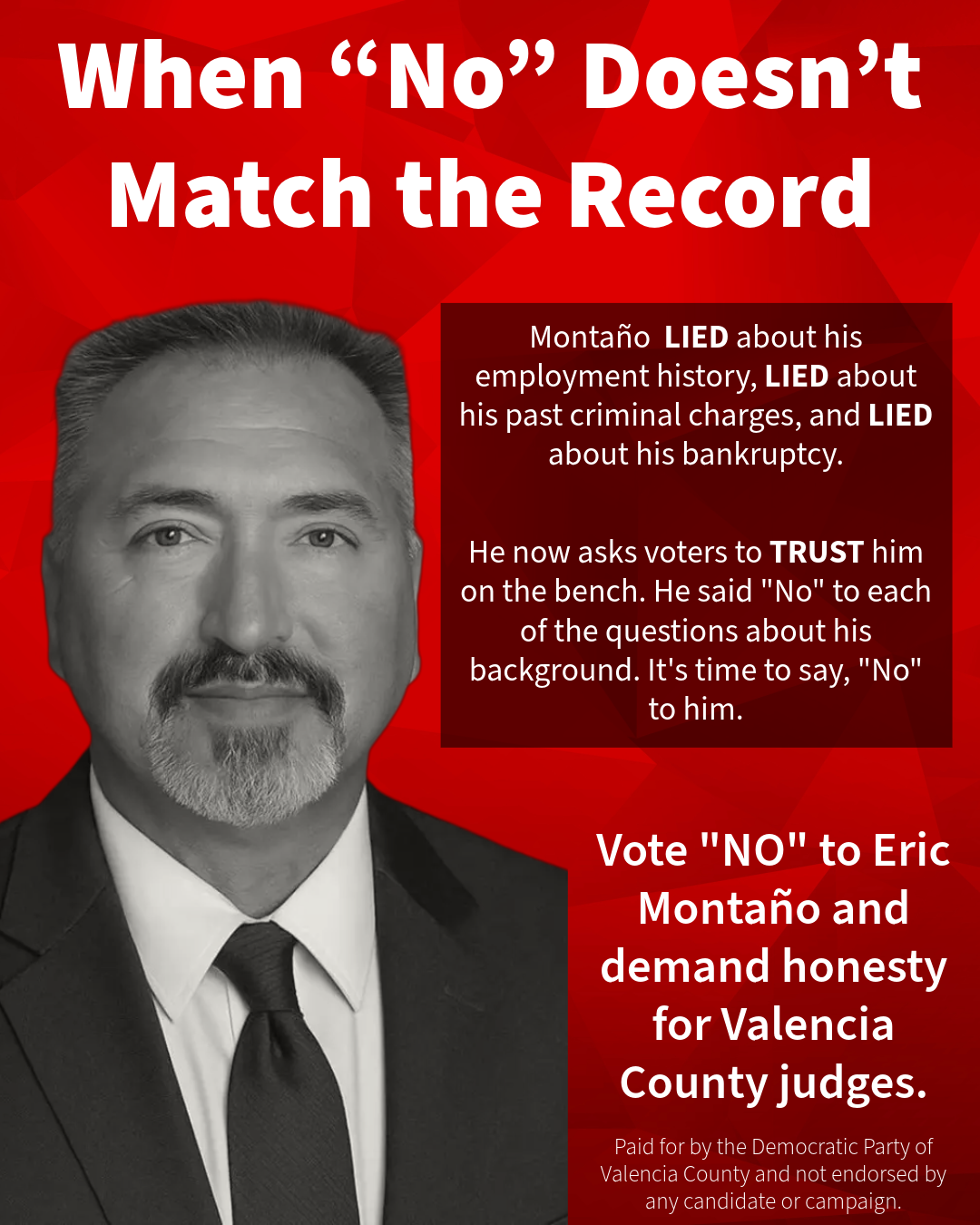
When “No” Doesn’t Match the Record
Eric Montaño says he believes in honesty, accountability, and taking responsibility. But voters now have public records they can compare with answers he gave during this campaign.
On September 21, Montaño, the Republican candidate for Valencia County Magistrate Judge Division III, posted a statement titled “A Moment of Reflection, Grace, and Truth.”
In it, he admitted that two answers he gave earlier this year were wrong. He said he misread one question and misunderstood another.
People make mistakes. A dismissed criminal charge is not a conviction. Bankruptcy does not make someone a bad person. Jobs can end for many reasons.
But that is not the issue.
The issue is whether voters received accurate answers when they asked direct questions of someone seeking to become a judge.
The criminal-history question was explicit
In the Valencia County News-Bulletin’s May 7, 2026, candidate questionnaire, Montaño was asked:
“Have you ever been arrested, charged with or convicted of drunken driving, any misdemeanor or any felony offenses in New Mexico or any other state? If so, explain.”
His answer was: “No.”
The same questionnaire also asked whether he had ever filed for bankruptcy. Again, his answer was “No.” The questions and Montaño’s answers appear together in the News-Bulletin election guide.
Court records tell a different story.
In 2006, Montaño was charged in Valencia County Magistrate Court with three counts of battery against a household member. The criminal complaint identifies the charges as misdemeanors. The case was later dismissed.
Montaño now acknowledges that the charges were filed. In his Facebook post, he said he had “overlooked” the words charged and misdemeanor when answering the newspaper.
But both words were in the question.
The bankruptcy question
The News-Bulletin also asked Montaño whether he had ever filed for bankruptcy.
Again, he answered: “No.”
Then there is the employment question
There is another answer that Montaño did not address in his September 21 statement.
At a News-Bulletin candidate forum, candidates were asked whether they had ever been terminated from a job or asked to resign instead of being terminated.
Montaño answered: “No.”
Employment records raise questions about that answer.
A June 2015 letter from the University of New Mexico told Montaño:
“I am relieving you from employment during the probationary period effective immediately.”
The letter identifies the action as a “Separation During Probation.”
Montaño’s own UNM employment application also lists his reason for leaving Savage QRS as “terminated after first incident,” following an incident involving a tractor-trailer. The application lists his departure from the Valencia County Sheriff’s Office as “Separation During Probation.”. (Files for employment termination are on pages 18, 35, and 36 in this document.)
Montaño addressed the criminal charge and bankruptcy in his new Facebook statement.
He did not address his answer about his employment history.
This is about accuracy, not perfection
Montaño says he believes in honesty, accountability, forgiveness, and growth. Voters can decide what weight to give his explanations. But the record itself is straightforward.
He was asked if he had ever been charged with a misdemeanor. He said no. Records show that he had. He was asked if he had ever filed bankruptcy. He said no. Records show that he had.
He was asked if he had ever been terminated or asked to resign instead of termination. He said no. Records show UNM ended his employment immediately during probation, and his own employment application describes another job as ending in termination.
The question is not whether Eric Montaño has a past. Everyone does. The question is how someone seeking to become a judge handles the truth about that past when asked directly.
Two records for voters to consider
Montaño is running against Democrat Rorik Rivenburgh. Rivenburgh has a very different work and service history. He worked for UPS for 30 years and served as a union shop steward for more than 20 years. While working full-time at UPS, Rorik earned his bachelor’s degree in Business Management. Since retiring he works as a Tour Guide and volunteers as a Court Appointed Special Advocate for foster children and as an Aging and Long-Term Care Ombudsman for people in senior living facilities. He and his wife have also been married for more than four decades.
Those facts do not decide the election. They give voters another record to examine.
The person behind the bench
A magistrate judge is not applying for an ordinary job. Magistrate judges hear evidence. They listen to testimony. They make decisions about credibility. They hear misdemeanor and DWI cases and handle civil disputes that can affect people’s money, homes, and families.
People who enter that courtroom may be asked to tell the truth under oath. Their words may be questioned. Their explanations may be challenged. The judge will decide which facts matter and whom to believe.
There is a question each voter must answer for themselves: If you were the person standing in that courtroom, is Eric Montano the type of judge you would want to face?